Opening a bank account, joining a gym, enrolling a child at school, taking a mobile contract, registering with a doctor, or applying for a visa all reach the same step: please provide proof of address.
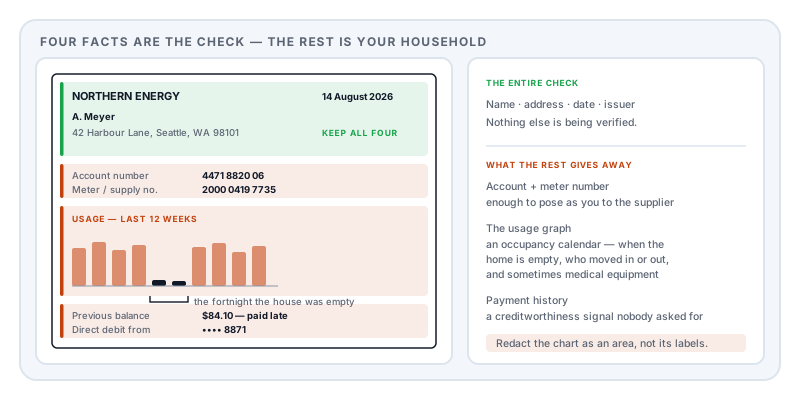
The check is looking for four things. Your name, your address, a recent date, and evidence that a real organisation issued the document. That is the entire test.
A utility bill satisfies it — and carries a page of other material that has nothing to do with where you live.
What the bill discloses beyond your address
The account number and the meter or supply number. These are the credentials for your relationship with the supplier. Someone holding your name, address and account number has enough to phone the supplier as you, and in some markets enough to initiate a switch of supply.
The consumption graph. This is the one nobody thinks about, and it is the most revealing thing on the page. Energy usage is an occupancy signal:
- A flat or near-zero fortnight says the property was empty for exactly those dates
- A step change says somebody moved in or out
- Consistently high baseline usage can indicate powered medical equipment in the home
- Weekday-versus-weekend patterns describe when the house is usually occupied
You are handing a stranger a calendar of when your home is unattended.
Payment history and arrears. Many bills print the previous balance, whether it was paid on time, and any outstanding amount. That is a creditworthiness signal you were not asked for, and if you have been in difficulty, it says so.
Direct debit details. Bills routinely show the account the payment is taken from, sometimes with partial digits and the payment date.
Vulnerability or priority-service flags. Suppliers in several markets maintain registers of customers who need additional support — people dependent on powered medical equipment, people with certain disabilities. Where a bill notes this, it is health data, which Article 9 of the GDPR treats as special category personal data requiring a higher standard of protection. A gym did not ask about your medical needs.
What to keep
Redact too far and the document fails the check, which costs you a week. Leave:
- Your full name, spelled as it appears on the application
- The complete address, including postcode or zip
- The issue or statement date — most checks require it to be within the last three months
- The supplier’s name and branding, so the document is identifiably from a real organisation
- Any document reference that is not your account number, such as a bill number, and page numbering
What to remove
- Account number and customer reference
- Meter or supply point number (MPAN, MPRN, or the local equivalent)
- The usage graph and any consumption tables
- Payment history, previous balance, and arrears
- Direct debit or card details, including partial digits
- Tariff name and unit rates — rarely harmful, never needed
- Any online account identifier or login hint
- Other occupants’ names, where a bill is in joint names and only you are being checked
Ask before you assume
One honest caution. Anti-money-laundering checks are the exception. A bank or a regulated financial firm opening an account for you is performing a legal identity verification, and some will not accept a document with redactions, because the completeness of the document is part of what they are assessing.
It costs nothing to ask: “I’d prefer to redact my account number — is that acceptable for your check?” Most say yes. If they say no, that is a real requirement rather than an inconvenience, and the alternative is to choose a document that reveals less in the first place.
Which brings up the better move in general: many suppliers issue a proof-of-address letter on request — a single page with your name, address and the date, and nothing else. Councils and government departments do the same. A document that never contained the sensitive material beats a redacted one, and it is accepted more readily.
The mistakes that undo it
A black box drawn in a PDF viewer is not a deletion. Most viewers add the shape on top of the page while the text stays in the file, recoverable by selecting the area and copying. That is the mechanism explained in redaction vs whiteout, and here the recovered text is your account number.
Cropping the page only changes what is displayed. Everything outside the crop is still in the file.
A phone highlighter is semi-transparent by design. Brightness and contrast adjustments in any photo app reveal what is under it.
The graph is an image, not text. Removing the numbers beside a consumption chart does nothing if the chart itself is still there — a reader can see the shape of your occupancy without a single digit. Redact the graph as an area.
The metadata. Utility PDFs are generated by billing systems that often write a customer or account reference into the document properties, where page redaction never reaches.
One more subtlety
A redaction box exactly as wide as the text it replaced measures that text. Researchers at the Privacy Enhancing Technologies Symposium in 2023 recovered redacted names from real published documents by matching candidates against the character positioning left behind, and found the leak in all eleven tools they tested.
On a bill this matters for short, guessable values — a meter number format, a tariff name. Quantising the box width removes the measurement.
Check before you send
- Select all, copy, paste into a plain text editor. Search for your account number and meter number.
- Search the PDF for the last four digits of each. Nothing should be found.
- Look at the page — is the consumption graph genuinely gone, or just its labels?
- Read the document properties for a customer reference.
Doing it
Redact PDF removes the selected text and image content from the file and rewrites the document rather than covering it — which matters here because a utility bill mixes text you want removed with a chart that has to be removed as an area. Metadata, attachments and comments are cleared in the same pass, and a second engine re-reads the exported file to confirm nothing remains extractable in the redacted regions.
It runs in your browser, so the document proving where you live is not uploaded to a stranger’s server on its way to proving where you live.
Sources and further reading
- Regulation (EU) 2016/679 (GDPR), Article 9 — health data, including vulnerability and priority-service records, as special category personal data.
- Regulation (EU) 2016/679 (GDPR), Article 5 — data minimisation.
- Bland, M., Iyer, A. and Levchenko, K., Story Beyond the Eye: Glyph Positions Break PDF Text Redaction, PoPETs 2023(3):43–61 — recovery of redacted text from character positioning.
- NIST SP 800-122, Guide to Protecting the Confidentiality of Personally Identifiable Information — assessing which identifiers carry the greatest harm on disclosure.
- ISO 32000-2:2017, the PDF 2.0 specification — text content, image XObjects, and crop boxes: why a chart and a line of text need different treatment.